
Step into the lighting restoration room at Olde Good Things, and you will find yourself in a maker’s workshop. Rows of copper and brass fitters, chandelier crystals, styles and gauges of wire, types of polish, brushes and tools and beautiful pieces of lighting from the gas age to modern day, all getting rewired, repaired, and ready for a new life.
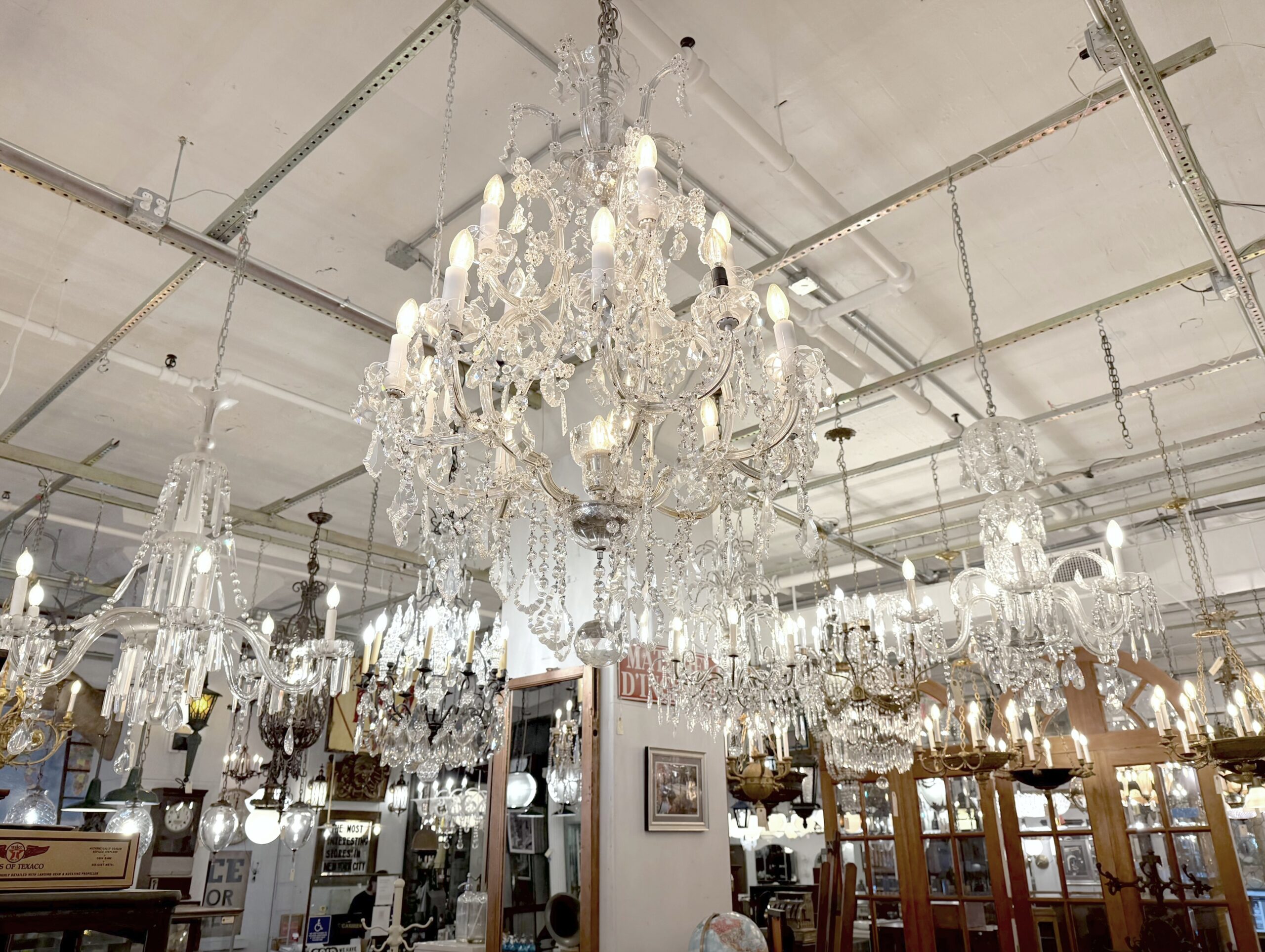
When commercial and civic architecture began to mature in the United States in the mid- to late-19th century, lighting was not an afterthought. Architects such as Richard Morris Hunt and Daniel Burnham designed buildings like The Breakers and The Rookery Building with fully integrated lighting plans, commissioning fixtures that complemented the scale, materials, and mechanical systems of the structure. In early skyscrapers and civic landmarks such as the Woolworth Building and Chrysler Building, chandeliers and sconces were engineered specifically for ceiling heights, sightlines, and structural supports.
In addition to designs that so clearly echoed its building, materials used for the lighting were substantial: solid brass, bronze, copper, etched or opaline glass. Quality was paramount. Foundries cast components in sand molds; ornament was hand-finished; arms were threaded and balanced to carry gas lines and, later, early electrical wiring. These were not lightweight decorative objects but infrastructural elements — durable, repairable, and built to last as long as the buildings themselves. We salvage these fixtures because they are architectural artifacts: products of a time when manufacturing standards favored weight, joinery, and longevity. This is why, when OGT enters a building under renovation, we always look up.
REMOVAL, TRANSPORT, AND ASSESSMENT
When we see a special piece, we build scaffolding or use lifts to carefully remove it. If the piece is large, we will label and disassemble it or simply pack it carefully for transportation. When the piece arrives at our workshop in Scranton, we assess the full piece, looking for any structural elements that need to be replaced, such as bent arms, chipped crystals, cracked finials, or a missing tassel. If it’s a gas light, we look for the original shades and assess those as well, ensuring they are not chipped or cracked.
Next, we assess the finish. In the decades following World War II’s rise of Modernism — and again during the minimalist “white box” trend of the 1990s — historic interiors were often simplified under layers of white paint, coating original brass, bronze, and plaster fixtures in the name of uniformity and brightness. When we encounter a painted fixture, we carefully remove some of the paint to understand the material beneath. Often, the original finish tells a much richer story. 1930s lighting, particularly Art Deco fixtures, frequently incorporated multiple finishes — a gilt base accented with deep reds or greens to emphasize relief and dimension. Our goal is to uncover and understand those original layers before deciding how best to proceed.


DIS-ASSEMBLY
We begin by taking the fixture completely apart — carefully, methodically — studying how it was originally assembled. No two manufacturers worked exactly the same way. Threading patterns, arm construction, internal channels for gas lines, and early electrification retrofits — each tells you something about when and how the piece was made. Joe Stren, explains, “There are some styles of assembly that we no longer use, and every manufacturer has their own techniques.” You see this most clearly in fixtures that began as candlelight or gaslight and were later French-wired for electricity, with sockets introduced into forms that were never designed for them.
Once disassembled, we build a parts list: the correct gauge wiring, period-appropriate sockets, bushings, and insulation. If the wiring will be visible — as it often is on a chandelier with exposed chain — we match it to the finish: amber-braided cord for polished brass, brown for antique bronze, clear or silver for nickel. At the same time, we evaluate grounding. Most early fixtures predate modern electrical standards, so we look for a discreet way to introduce a ground wire — identifying a secure attachment point within the body that won’t disrupt the structure or the appearance.
With everything apart, the real work begins. Each component is cleaned and assessed. Structural elements are repaired or replaced where necessary. Finishes are addressed individually — polished, stabilized, and even replated if needed. Paint added in later decades is removed when it conceals the original metal. And throughout, we are careful not to erase history. The goal is not to make the piece look new, but to return it to working order while preserving the patina and character that only time can produce.


RESTORATION WIRING
Rewiring is one of the most critical stages of restoration. We begin by removing outdated wiring and sockets, then evaluate the fixture’s materials — brass, bronze, glass, or composite metals — to ensure cleaning methods align with the condition of each component. Once prepared, we install period-appropriate sockets and new wire selected specifically for the piece.
Wiring requires skill, research, and attention. First, we determine what type of wire to use and the type of coating – while plastic coating is common now, many decorative pieces require cloth-covered wire instead.
Rule of thumb: When considering gauge size can often be used as a guide. Heavy gauge wire rated for 220 watts (#12) is used for large, multi-socket antique chandeliers, sconces, or hanging lamps. The thinner #18 gauge wire, rated for 20-30 watts, is sufficient to safely restore antique lighting with thin, delicate arms. When wiring, also consider the length required. For a chandelier or pendant, you will need enough wire to weave through the length of the chain into the ceiling.
After the length, gauge, and coating are selected. The wire is stripped at the end for connection to lighting terminals, a plug is attached, and candlestick fixtures are completed with a new sleeve.


STRUCTURAL REPAIR AND FINISH WORK
Now that the piece is cleaned and re-wired, we turn our attention to refinishing the surface. Our goal is typically to restore the light to the authentic beauty of its original finish, however upon request some work can be done to tonally shift the piece to better work within the design or color palette of a new room. We paint or use chemicals to lighten or darken brass, or apply a specialized resin to solidify the structure of materials, such as antique spelter, which have become brittle or weakened by time. The goal is to restore not only a light’s beauty, but also its strength.
GLASS, CRYSTAL, AND EMBELLISHMENTS
Now it’s on to the finishing touches. Over the years, we’ve built a large collection of hardware and embellishments, including chains, finials, shades, canopies, globes, prisms, screws, keys, and more. “If there are missing pieces, we will use parts from others we have or purchase new pieces like crystal and crystal arms for chandeliers. We always try to use vintage replacement parts.” shared Haroldynne Rannels, OGT warehouse manager.
The result is a gorgeous piece that transforms an entire room. Contact us with questions about your antique lighting needs or any special projects. We are here to help.

