Step inside Olde Good Things’ Scranton warehouse to discover a rare collection of vintage stained‑glass sheets. Stained‑glass artist and historic preservationist Alexandra Wolfe explores how evolving glassmaking techniques shaped the texture and beauty of these pieces—revealing the craftsmanship behind every luminous pane.
Deep inside the Olde Good Things warehouse in Scranton is a sparkling trove … that we don’t actually mean to keep locked away: a collection of vintage stained-glass sheets. These are the manufactured products before they’ve been cut into shape for the windows, panels, lightshades, or mosaics more commonly associated with “stained glass”. Alexandra Wolfe, a stained-glass artist and historic preservationist, visited our collection recently to help us explain why this vintage collection, acquired from a recently shuttered stained glass repair studio, is so phenomenal.


The Texture of Glass
The early 20th century saw a proliferation of industrialized glass-making that displaced hand-blown and early machine-rolled glass from being the only production options to being preserved as rarified artisan skills.
- Crown glass was produced by blowing a hollow orb (also called a “crown”) and flattening it out into a disk via centrifugal force. The central part of the disk would remain thick and textured, sometimes called bottle-glass windows. The outer edges of the disk would be smoother with slight rippling texture. This area would be cut into squares and triangles for leaded glass windows.
- Cylinder blown glass was a hollow cylinder of glass sliced lengthwise and reheated until it unrolled into a flat pane. This method resulted in the larger pains with reeds, seeds, and slight distortion familiar as Georgian and early Victorian era windows.
- Rolled plates were made by passing molten glass between two metal surfaces—smoother, but still lightly grained. Patented in 1838 by James Hartley in the UK, this method made glass panes immediately more accessible, marking the advent of glass architecture like glasshouses or the Crystal Palace for the Great Exhibition of 1851.
Whether by hand or machine, each production method produced textured glass sheets. It wasn’t until the 1950s advent of float glass, made by floating the molten glass on molten tin, that a perfectly flat glass surface was achieved. This remains the industry standard for clear glass.
Beyond manufacturing possibilities, there is another consideration in texture: intentional texturing. Many stained glass sheets were purposefully textured to add depth to the final product, often in the glass used for robes, wings, or even petals. Each artisan, and then factory, would have produced these textured glasses slightly different, further widening the differences in glass textures ….
Pigmentation in Glass
… and that is before we start adding pigments to the puzzle. The combinations or, in some cases, neutralizations of materials used to achieve particular glass hues have changed throughout history, due to local accessibility and opportunity. can be used to achieve different hues and coloring. For instance, studies have shown that lead antimonate was used to produce yellow-hued glass in the ancient world, whereas modern glass makers have turned to cadmium. The amount of colorant used, the purity of the colorant, other minerals in the materials—a range of variables can influence the glass pigment and how it interacts with light.
The changes in chemistry and production through history have massive implications for preserving old stained-glass pieces: each individual pane that is cracked or missing is a unique challenge. As Alexandra points out, “When you need to replace a piece of colored glass in an old stained-glass window, your challenge is to find something that matches the original’s texture and color in both reflected and transmitted light. When you have access to glass that was made around the same time, you have a better chance of finding a reasonable match.”
Working with Old Glass
But what does working with these sheets of glass look like? Turns out, the surface texture of the glass is not only critical for looks but for working the glass as well. Alexandra explained, “Usually, the smoother the glass, the easier it is to cut. When glass has a lot of surface variation like bumps or irregular swirls or changes in thickness, it’s hard to score evenly as a set up for a clean break.”
During her visit to our warehouse, Alexandra explored our vintage stained glass collection before demonstrating a clean break, shown in the video below.

Our last technical question for Alexandra was about difficult glass, if there were any particularly challenging types to work with. The question brought us full circle to talking about intentionally textured glass sheets …
Some of the hardest glass to work with was dreamed up in Louis Comfort Tiffany’s studio. It was developed to physically mimic the drapery folds of the robes worn by saints and angels. Called drapery glass, its thickness could vary from an 1/8 to 5/16 of an inch (sometimes more) across very short spans. It was also used for flowers as seen in the Met Museum’s magnolia panel … I have no idea how people cut that stuff with only hand tools back in the early 20th century.
While drapery glass wasn’t what Alexandra was after during her visit, she did find something else: her favorite type of glass for mosaics, “streaky opalescent glass of varied colors in natural hues”
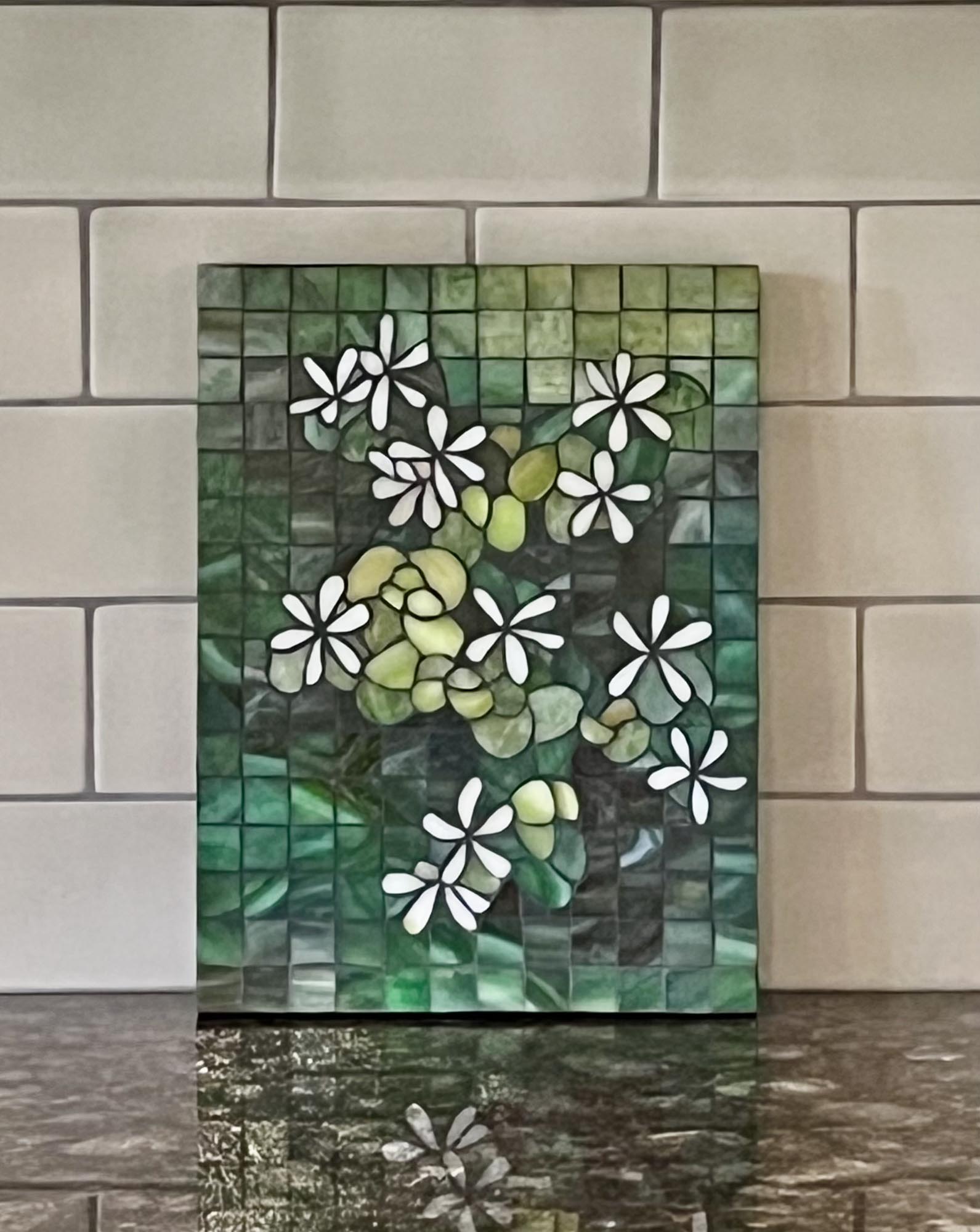
There is the phenomenal bit about this vintage glass collection: these sheets are more and more unique nowadays, made in styles, textures, and pigments that are no longer commonly manufactured. They are each a remarkable piece of history, ready to either help preserve a larger vintage piece or be a part of a new creation. We have only a small part of the full collection listed online, so if you are looking for a specific style of vintage glass, chances are we have it. We invite artists and creators to schedule a visit at our Scranton warehouse to select and cut your own vintage glass pieces, contact us today to arrange a time.