
At OGT’s Scranton Iron Yards, founders explored the company’s extensive collection of reclaimed architectural metals, exploring welding techniques and restoration methods along the way. The tour underscored the importance of sourcing and preserving antique materials through efficient salvage operations—highlighting how industrial skill and historical stewardship combine to sustain craftsmanship and reuse.
In Scranton, Pennsylvania, at 400 Gilligan Street, you’ll find our National Warehouse, surrounded by three iron yards. Over the summer, five of our managers and specialists gathered to share metalworking highlights from those yards.
In less than an hour, we toured a huge collection of fantastic pieces representing a broad range of styles, eras, and uses. That is Olde Good Thing’s point of pride: to source high-quality antiques and save them from the scrapyard. To do that, we’ve spent years building relationships with demolition crews and pickers around the East Coast and the world, a global network we keep (at least) two eyes on every day to bring the best of antiques to Scranton, New York, and LA—ready for you.
Today we’re sharing a recap of the items we saw and answering some of the questions you asked during the event, but first, a quick look at metalworking history. You can skip through each item featured in the video using the ‘Chapters” feature on the YouTube video’s page.
Welding 101
Welding has technically existed in some form since the Bronze Age, when Ancient Egyptians were pressure-welding swords. However, it wasn’t until the 1800s that welding as we recognize it began to develop, and it still wasn’t until the industrial advances brought on by the world wars in the early 1900s that welding became a common practice.
Therefore, a good deal of the metalworked pieces in our iron yards are pinned instead of welded. Joe, our NYC showroom manager, explained pinning while standing over an 1800s NYC balcony: the metal would be heated red hot, a hole struck with an awl, and a pin pushed through; the cooling metal would expand and cinch around the pin. Welding was easier to reproduce consistently with greater load capacities, so it did replace pinning–but the artwork and craftsmanship of pinned metalworking remains unparalleled.
Cupolas, Fences, and Doors: The Items We Saw
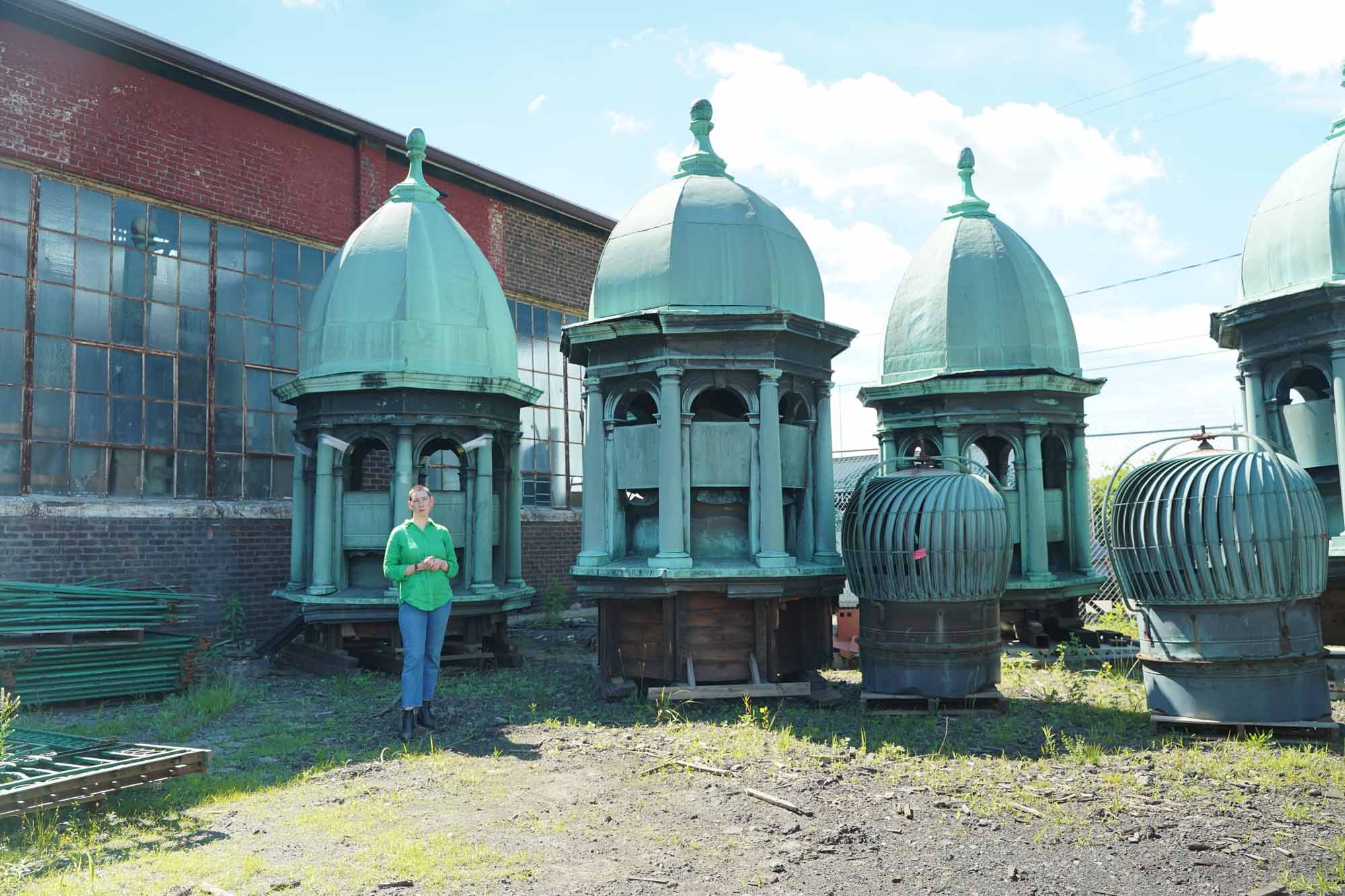
We started our tour with seven copper-clad cupolas from the Harrisburg State Hospital, turn-of-the-century builds so sturdy OGT was able to lift them off the hospital roof via crane; no dismantling involved. (We got a bonus peek at three date stones and some hand-carved corbels from the same complex.)
Haroldynne, our hardware and social media manager at the Scranton warehouses, joined us to share a unique piece: a mixed-metals set of entry doors from Argentina. Al, our Gillian Street warehouse manager, stepped out to show us pallets of nautical chains. Two sets of chains with round rings were dug out of the sand at Port-au-Prince, Haiti, while several other pallets bore 8” and 9” anchor chains. Our nautical chains are not online yet. Please reach out to our sales team for details.


Some pieces we saw were designed for specific locations, like iron newel posts from Brooklyn Brownstones and a balustrade run from the Stirling Hotel in Wilkes-Barre, PA. Others were notable for where OGT had reclaimed them from, like a piece of wrought iron fence that was already reclaimed by the time it was hung on the wall at Blackies House of Beef in Washington DC. OGT also reclaimed a balcony railing from Blackies that didn’t make it into this tour.
Other pieces were interesting for the purposes they were meant for, like window guards from the backside of the Coach brand headquarters in Hudson Yards or a run of mid-1800s anti-climb spikes pointed in multiple directions, intended to top a brick wall. We also saw solid forged iron fencing with horned points, used atop NYC buildings to prohibit rooftop jumping. Throughout the event, we saw an array of other fencing options as well, from late-1800s cemetery fencing to Art Deco pieces with the Dolce & Gabbana insignia.

The tour rounded up coming full circle to look at two last cupolas and cast-iron bases for outdoor lighting, plus a couple of fire escapes. We were able to see where the lighting bases had originally been fitted with access panels for electrical wiring. While OGT acquired them with rough cut top edges, a proffered recommendation was to grind the tops flat and reuse the pieces as table bases. Inquiries around how to use salvaged pieces were actually a fair number of the questions we received during the live event, so here are some answers ….
Q&A From the Iron Yards
Who should I contact for first steps?
If you already know what sort of piece you are looking for, and you don’t need a third party to accomplish it, then we are on hand and ready to help you find the perfect piece.
If you have something in mind that’s a bigger project–a new build, structural renovation, interior redecorating, Joe recommends reaching out to an architect, designer, or relevant craftsman in your local area.
Ask your designer or architect to collaborate with Olde Good Things. We work with industry professionals frequently; our team will be more than happy to work with you and your team.
Sandblasting and powder-coating were mentioned as next steps in the video, but what are they?
Sandblasting is an abrasive cleaning, similar in concept to sanding old paint or varnish off cabinets—except stronger. It can be used to remove rust, paint, dirt, and other surface issues from metal, wood, concrete, and brick. A quick search for “sandblasting near me” should give you plenty of local options.
Powder-coating is an electrostatic application of dry powder, used to protect against rust and other surface damage. The combination of both allows the piece to be fully cleaned and then sealed to prevent rust or other surface issues from reoccurring. Power-coating is helpful especially if your item is going to be outside.
I love the idea of using an antique item, but what do I do with it?
One of the most exciting parts of this industry are the opportunities we have to see what people will do with these fantastic, salvaged items to give them a new purpose. We’ve seen a wide range, here are just a few of our favorites:
- We’ve seen nautical chains, elevator gears, and horned fences turned into tables.
- Stone pieces, from mantels to lintels, are frequently set into walls.
- In the spring, we mentioned a hardware store cabinet that had been repurposed for kitchen use.
- A cupola from the set we started the live event in front of was reused atop a barn; another was used as a side-yard coffee spot.
- Here at OGT, our Altered Antiques department has repurposed windows into mirrors, water meter covers into table tops, and a variety of other creative notions.

If you’re looking for inspiration, check out our Altered Antiques category and social media accounts, where we frequently share customer projects. Keep in mind, we don’t take custom orders, but we are always happy to offer ideas, collaborate with you and your design team, and help you find solutions.
We spent nearly an hour in our iron yards, but barely scratched the surface of our stock. The possibilities for your spaces and projects are endless, and we’re only a phone call or email away to start sourcing your perfect salvaged treasure. We look forward to hearing from you.


